A short story by Ron Wilbur
Crossing the border isn't hard, it's just the usual rigmarole. No big deal. This is the beginning of the Mexico part of a fishing trip for seven guys - a border crossing is just part of the process.
Finding where to get an immigration card is not so obvious. The big Mexican immigration building has one visible doorway on the side but there are several possible ways in, the side doorway being just one. That’s not so intuitive, nor are the stairs or elevated sidewalk with handrails that you would have to jump over to get on the sidewalk.
That figured out, Mexican immigration is easy. A Mexican immigration officer that speaks excellent English helps each fisherman fill out the form. In fact, he fills most of them out for guys, which makes the first encounter in Mexico not only pleasant but also quick and easy. It's early still, barely 8 am on the first day and already the trip has produced a good experience. This is the way every good trip should start.
Back in the two dusty vehicles, the fishermen continue south, winding their way through the Mexican border town and after never-ending suburbs eventually finding open road.
Now with little traffic, both vehicles pick up speed, making the arid, desert sand a blur out the side windows. In the distance, a mirage makes a blue sea appear where there is none. "Is that it?" "Is that really the sea?" is the thought that everyone thinks until the miles reveal that it's just more shimmering sand. That, of course, is followed by silent sighs. Fishermen just want to make progress. Endless sand isn't progress.
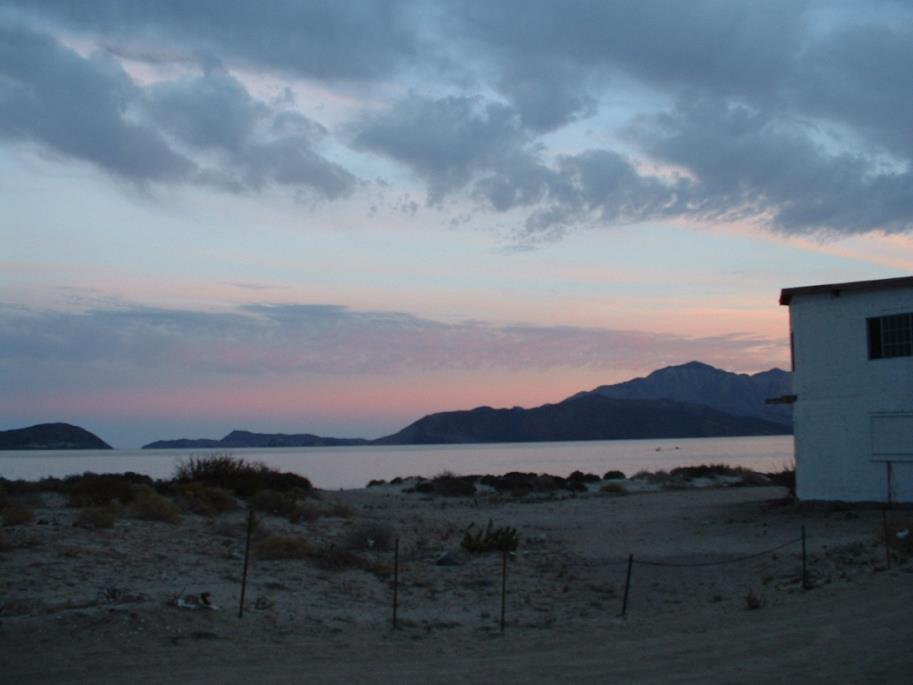
But of course, like all good things, the desert eventually yields to the blue of an actual sea, punctuated by hills and mountains of volcanic lava, most now reduced by weather and wind into rounded heights, occasionally still in sharp relief.
Water has a magical quality among fishermen, especially ocean-going fishermen. The sea is the magnet that keeps bringing your eyes back to it, marveling at its splendor, exploring its shapes, hypnotized by its color.
Of course, as every fisherman knows, It's not just water that captures the mind. It's the life that swims beneath its surface, punctures the surface with splash and fin, and plays with the sea birds that soar over its expanse. That’s what draws the fishermen.
Desert expands in places, punctuated by brackish water, white channels and salt flats threading through the sand.
Time and vehicles almost fly, and the two vehicles come to a town with the typical far-stretching outskirts of many such towns in Baja California. It's as though outskirts people chose to live outside the city so they could keep their solitude while being close to the goods and services available in the nearby community.
It's 11 am now, and the seven fishermen experience the growl of stomachs that need food, hopefully soon.
Fortunately, both sides of the road through town are splattered with taco stands and other eating options. Birria tacos and beer sounds good, and the fishermen settle in with locals to enjoy the specialty of the taco stand with the most people in it. Everyone knows that places that are packed with people are usually packed because they have better food than their competitors. So far so good.
Now reloaded and reboarded in vehicles, the fishermen continue the journey, cross the land like a camel pack train across a desert expanse, with occasional vistas of sea and fishing villages.
Eventually, the vehicles reach the stretch of road to the fishing village, their destination and home for the next four nights and days.
"Road" is a wholly inadequate description of a tarmac in terrible condition. What is next are ruts, holes and bad patch jobs that require rapid braking, quick, reactive steering and yells and bracing in anticipation as road holes become tombs that look like they could bury tires or worse. This part of the trip is irritating and longer than it's distance.
The vista overlook as the vehicles crest and begin to descend into the village gets reaction as men draw in their breath in each vehicle. Wow. The journey is definitely worth it.
Driving through the bay village, both vehicles find the hotel where the fishermen climb out, check in to their rooms, and unload their baggage.
Next up, a trip to a beachfront palapa for shrimp quesadillas and margaritas/ beer while gazing out over an azure sea with soaring sea birds, a moored yacht in the bay, begging dogs. This is the moment when the fishermen can slowly exhale.
What caught the attention of the fishermen on the drive through town was a dilapidated but interesting structure on an abandoned stretch of beach. The architecture suggests that it might have once been a nightclub or fancy restaurant, with dramatical arches touching the second floor on either side. The land from gate to building is empty of everything except scrub brush and sand.
The building still faintly shows the promise of someone’s dream of a place for parties, dancing, dining and wonderful evenings. That dream has been dramatically diminished by time and neglect into a somewhat distorted shell, still eye-catching, but obviously not habitable.
Over quesadillas under the palapa the fishermen remark on the interesting building.
"That would make an amazing night spot, wouldn't it?" says one.
"Yeah, but can you imagine what it would take to fix it up?" comes the response from another.
"Probably a hole you can bury money into," says a third.
"Maybe. Wonder what regulatory hoops you have to jump through to get any renovation approved here," from the first.
"Well, it's a small fishing village in Mexico. There probably isn't a lot of bureaucracy, and I bet they don't have to jump throught the hoops we have to in the states."
Others in the group nod as they agree on the fundamental difference in cultures.
But, back to the purpose of the trip - fishing, and fishing over the next three days varies.
The first day is slam, bam, thank you fish, followed by beers and good local food at a nearby eating establishment ("restaurant" being too lofty of a description). Dinner conversations include more conjecture about the beach building, and opinions from the fishermen with construction experience.
"You'd have to have that place seriously inspected for safety. It looks like it's shifted a bit over time."
"Sure, but you wouldn't have to worry about OSHA or EPA or any of that other crap. Bet they don't have that down here."
"Right, which is why some buildings fall down and kill people."
"Didn't see any collapsed buildings on our way here. Besides, if you did a good job of it, I bet that place could be solid, and a hot spot for the Americans that come here, if not a draw for more."
"Probably have to grease a few palms to get the 'authorities' to sign off."
It's all just musings. No one really takes the conversation seriously.
But this is early on, and it's soon clear that the camaraderie among the fishermen is molding them into a group, not only of common interest, but of shared personalities and attitudes.
The second fishing day is slower. Fish are elusive and reef sharks outnumber everything else, chomping on bait fish and not even saying thank you for the fine meal. Everyone imagines the sharks belching and being grateful for the delicious food, while they’re also thinking about the terrible ways they'd like to kill those wily bait stealers.
That night, sitting on the deck of the hotel, quaffing cold brews, the conversation turns again to the abandoned building.
"I still think that would be a great club, you know?"
"How would you even get started with something like that?"
"Don't know, but if a bunch of guys got together, I bet they could figure it out. And they'd have a club house to come to when they came back here. Hell, we'd be like heroes to the locals and studs to the fishermen that come here." That comment was the first to suggest any potential for the group.
"Let's go take a closer look at it tomorrow after we come off of the boats. You know, see what shape it's in, just for the hell of it."
"I'm in. Let's do it." That comment is met by "Why not" "Sure" "Ok."
Dinner is another good meal that night. Table conversation goes back to the building and the promise some guys think it holds. All agree that it's a fun topic, but most don't take it seriously, even though several of the guys have construction experience that gives them real-life perspective.
Fishing the third day is better. Less wind, fewer sharks, and a ton of smaller fish to fill freezers and provide tasty meals to enjoy at home.
After coming off the boats on the triumphant last day, guys get cleaned up and then travel the two blocks to the abandoned building, parking along the street and walking the land to the structure.
Over the driveway from street to building are two semi-arches reaching in from each side, remnants of a vision that someone had for an ostentatious club in the middle of a tiny fishing village in Baja. The short dirt road to the building shows evidence of wind, rain, more wind, more rain, that have drenched and shifted the land surface over time. The scrub trees are stark and help complete the picture of abandonment. Still, the structure stands with a shadow of its dramatic architecture like an alluring beacon, or in some minds, like a lighthouse that signals danger ahead.
Guys examine the structure from the outside, cautious of any evidence that their entering the building might lead to a disastrous collapse. After assuring themselves and each other of its structural soundness, the seven warily walk into the first floor.
It's essentially a large box. Four exterior walls, with some interior partitions. Walls are constructed out of concrete blocks with some evidence of internal rebar. Not a bad foundation and there also doesn't seem to be any shifting of the building; just typical aging from the elements.
From a distance, it had looked like the tricky part would be getting up to the top floor, but that doesn't turn out to be the case. Like most construction in Mexico, the stairwell is concrete and internal to the structure. That method gives it longevity that wood never could provide. Upstairs is spacious and open, perfect for dancing, and with space for a large bar on the landward side of the room. The seaward side has amazing views of the bay and the reach of beach leading down to it.
"Wow, this place has good bones."
"Yeah, it's not as bad as it looked from the road. Someone had a vision."
"It might be possible to fix this up. Just getting materials here would probably be the major expense."
"I bet we could fix this place up for $10k, US."
"Maybe, but it's a hell of a lot of work."
"Yeah, but if we shared it with the community, the locals might kick in with labor and pride of ownership. We could co-own it with a deed that gives it totally to the community after 20 years. That gives us plenty of use and enjoyment, and when we’re too old to use it the place reverts to the community. In the meantime, we should get verbal agreements of a purchase in principle."
"Hmm, after it’s fixed up it could be our clubhouse, for when we come down. We could stay here in the rooms below, have a place to hang out, eat and drink, and it would be a place we could call our own. We could let a local hotel rent out the rooms when we're not here."
"Dang, that sounds really cool. I'd be willing to kick in $5k."
"I'm in."
"I'm in."
The verbal commitments total $30k, probably more than enough to buy the land and building shell, restore the building and still have a little money left for operating expenses. There is some belief that the town would like to see the eyesore restored and might broker a steal on the purchase price because they would be the eventual owners.
After completion of the work, the club would be a wonderful attraction and amenity for tourists and fishermen.
All that sounds interesting and even possibly exciting. The stars seem to be aligning for a successful move forward.
The next day, the fishermen check out of their hotel, pack their vehicles and head north to return home. The conversations in each vehicle include lots of further thoughts on the prospective "clubhouse."
Less than three hours after departure the two vehicles pull into a larger resort town to find lunch for the hungry travelers.
Sitting in the air-conditioned room of a local eatery, the discussion on the clubhouse continues in a lively direction. Almost every guy is talking up the idea, with only one being quiet. When it's his turn to jump into the conversation, the lone guy offers his thoughts.
"I've been thinking about this since we first started talking about that building. First, this is a different culture with different laws from ours. We're the outsiders, investors from another country. I just wonder if we'd be as welcomed as we hope we would be. Plus, there's the greasing of palms that is common here."
That comment seems like kind of the keystone. Open that lock and the last reluctancy could dissolve.
"Hey, we're pretty smart guys. And we know some pretty influential people in the town. I bet we could make this happen."
A couple of guys nod in agreement, and then turn the conversation back to how, when, how much and why.
"We can name it whatever we want. But, it should have our brand as a clubhouse. If we pick a good name, it can serve dual purpose - be our identity, but also be good as a standalone attraction."
"Yeah, that makes sense. If we call it something cool, that could be our club's name and also the name of the business. That's a bit tricky but I think we could come up with something that would work."
"Well, what would you call it. What are some names."
"How about the Cortez Beach Club?"
"Good, but wouldn't work well for a group name."
More names are suggested: Dirty Pleasures, Club Azure, Club de Pescadores, Playa y Mar, Pescado y Mar. All stimulating and fun to come up with, but nothing that really stands out.
Lunch finished, travel resumes and by late afternoon, seven tired fishermen have safely returned to their homes and families.
Interest wanes on the club idea until the group gets together in a few weeks for a group lunch.
Within two drinks the conversation returns to the clubhouse idea. After another drink and more agreement, the group stacks hands on pursuing the idea.
Calls, emails, texts and messages to prominent business people in the fishing village reveal that the town has no vision for the building and would probably be interested in talking further about the idea of restoring it.
Two years later, Club Pescadores opens with a private launch party. Present at the party are the mayor and the most important people in the village. They have already taken private tours during construction, but now they can see the final form, with lighting, sound system, spacious bar, excellent kitchen and of course, rooms down below that can be income producing when club member/investors aren't in town.
Seeing this great new landmark and attraction, the town leaders catch the vision and, as part of their partnership, quickly plan to build three beach-style buildings with 15 rooms, and camping spaces for 10 RVs, on the land surrounding the Club. A sea water pool will follow shortly after.
The vibrant club soon becomes a landmark, the outstanding symbol of the revitalized village and a favorite hangout for fishermen, tourists and other visitors to the town. Businesses prosper as word spreads through the internet, travel sites and fishing forums. The buzz brings more business, which funds expansion for existing businesses and investment capital for new businesses.
All of this new prosperity and community excitement comes about because seven fishermen travel to a fishing village in Mexico on a five-day fishing trip, fall in love with the area and the experience it offers, and catch a vision.
"Larga vida a la vision!" (Long live the vision!)
Cover image from Wikimedia Commons